Table of contents
Toggle- Understanding What a Non-Current Model Really Is
- Purchase Price and Incentives: A Clear Edge for Non-Current Models… But Not Always
- Buying vs. Leasing: The Model Year Changes the Strategy
- Ownership Horizon: The Factor Too Many Buyers Overlook
- Technology and Evolution: Should You Worry About “Missing Out”?
- So… Should You Take Advantage of the Promotions?
- Conclusion — The Smart Pickup Isn’t Always the Newest One
- Foire aux questions (FAQ)
Understanding What a Non-Current Model Really Is
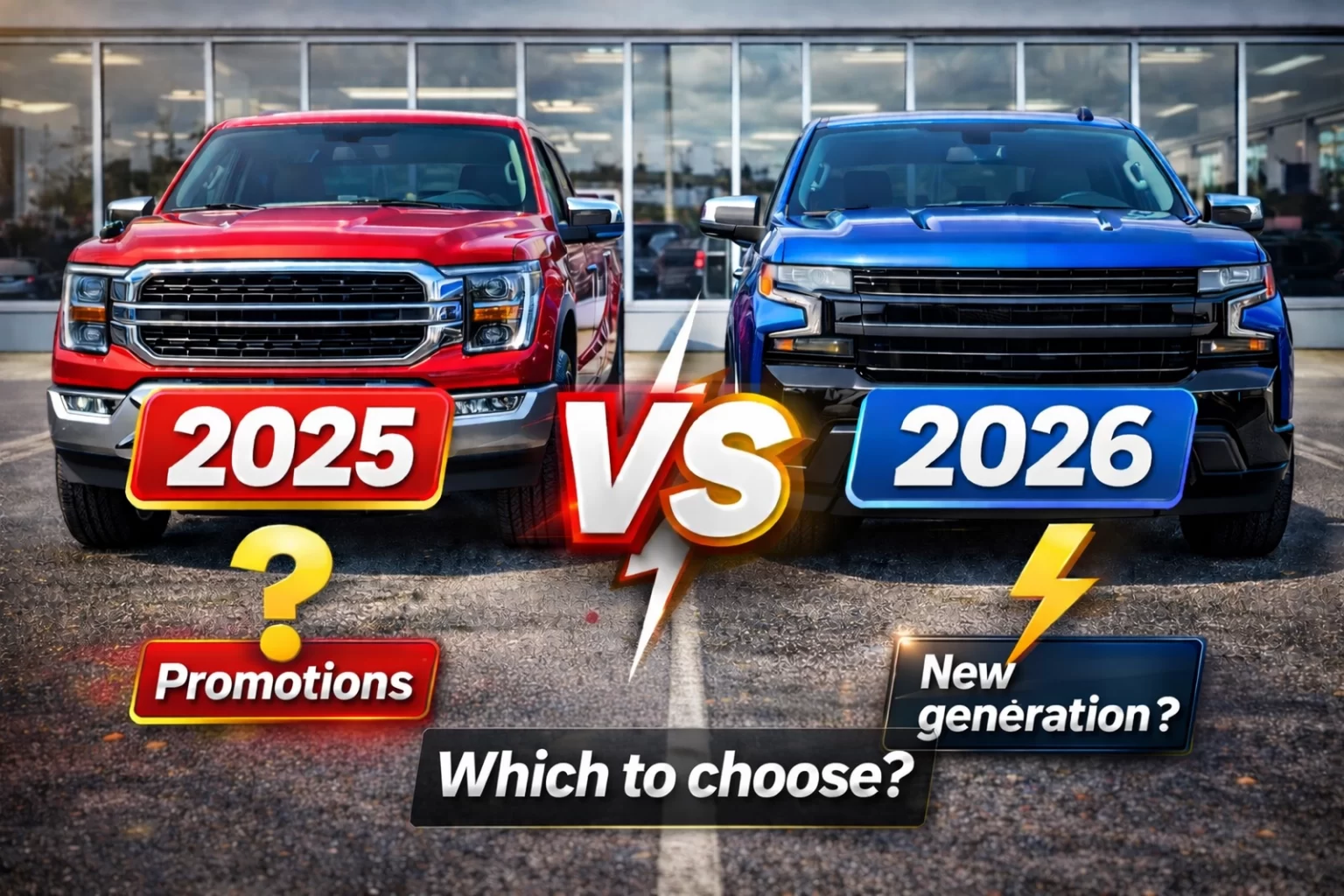
A non-current model is not an outdated vehicle. In most cases, it’s simply a truck whose model year has changed while the vast majority of features and specifications remain the same. In the automotive world, product cycles often last six to eight years, with major updates typically arriving midway through that cycle. When no significant redesign is introduced, the differences between two model years may be limited to:- a new colour option
- an available package
- a software update
- minor equipment adjustments
Purchase Price and Incentives: A Clear Edge for Non-Current Models… But Not Always
✔ Advantages — Non-current model (2025 at the time of writing)
The main appeal is financial. Manufacturers rely on several levers:- direct rebates
- subsidized financing rates
- loyalty programs
- trade-in bonuses

❗ Drawbacks
However, you must accept a psychological — and financial — reality: the moment you drive off the lot, your truck is already considered “one year old.” This can influence:- resale value
- future buyer perception
- certain financing structures
✔ Advantages — Current model year (2026 at the time of writing)
Choosing the current model year brings peace of mind. You get:- the newest product
- stronger perceived value
- a longer lifecycle before the next generation arrives
❗ Drawbacks
The main one is obvious: you’ll pay more. Promotional rates are often harder to find, and negotiation margins tend to be tighter — especially when demand is strong.
Buying vs. Leasing: The Model Year Changes the Strategy
If You’re Buying
Non-current model — often the smartest financial play For buyers planning to keep their truck long term, a non-current model makes tremendous sense. Why? Because depreciation matters less over time. After eight years, whether it’s a 2025 or a 2026 rarely changes the equation. You benefit from the discount without truly feeling the downside. Ideal profile:- long-term owners
- contractors and tradespeople
- high-mileage drivers
- pragmatic buyers
- frequent upgraders
- resale-conscious buyers
- drivers seeking the latest features
If You’re Leasing
The logic shifts entirely. Leasing relies heavily on the manufacturer’s projected residual value. Non-current model — watch the numbers Even with a rebate, an older model may carry a lower residual value. Possible consequence: the monthly payment may not be as attractive as expected. Paradoxically, some brand-new models benefit from highly competitive lease programs designed to support their launch. Current model — often more consistent for leasing You’re essentially leasing the vehicle during its strongest value period. Plus:- more modern perception
- up-to-date technology
- greater flexibility at lease-end
Ownership Horizon: The Factor Too Many Buyers Overlook
Before even talking price, ask yourself one question: How long will I keep this pickup? It’s likely the most important variable. Long term (7–10 years) The non-current model becomes extremely attractive. The upfront savings dominate the equation. Medium term (4–6 years) The gap narrows. Resale value begins to carry more weight. Short term (3 years or less) The current model often regains the advantage — especially with leasing.Technology and Evolution: Should You Worry About “Missing Out”?
Not necessarily. Major breakthroughs don’t happen every year. When they do — new powertrains, full redesigns, electrification — the news spreads quickly. If the generation remains stable, buying a non-current model can be an exceptionally smart move. However, if a significant change is just around the corner, think twice — it could impact the resale value of the outgoing generation.So… Should You Take Advantage of the Promotions?
The honest answer is this: 👉 The best choice depends less on the truck itself than on your ownership strategy. Choose a non-current model if:- financial logic is your priority
- you keep vehicles for many years
- year-over-year changes are minimal
- you upgrade frequently
- future value matters
- a major update has just arrived
- you plan to lease
Conclusion — The Smart Pickup Isn’t Always the Newest One
In the collective mindset, buying the latest model often feels like the logical choice. Yet for many owners, the real financial win is frequently found among non-current models. For many people, a pickup is first and foremost a tool — and sometimes even a work partner. What matters isn’t just the model year, but how well it fits into your daily reality. Buying smart doesn’t mean following the manufacturers’ calendar. It means aligning your vehicle with your needs, your ownership timeline, and your financial strategy. And sometimes, that means seriously considering a brand-new truck… that the industry already considers last year’s model.Foire aux questions (FAQ)
It depends on what changed between model years. If the 2026 brings a new generation or major powertrain updates, it may be worth the premium. If it’s a minor update year, buying a 2025 at a discount (typically 5–12% off MSRP) can be a smarter financial move.
Non-current model year trucks often come with manufacturer cash incentives of $2,000–$8,000 CAD, plus dealers may offer additional discounts to clear inventory. Total savings can reach $5,000–$15,000 on a $60,000–$80,000 truck.
No. Truck warranties start from the date of purchase, not the model year. A 2025 pickup bought brand new in 2026 receives the full factory warranty (typically 3 years/60,000 km bumper-to-bumper; 5 years/100,000 km powertrain).
Generally, a 2026 model will hold its value slightly better during the first 1–3 years since it’s one model year closer to ‘current.’ However, the initial purchase price discount on a 2025 model often outweighs the small resale value difference over a 3–5 year ownership period.
Check the build date (not just model year), inspect for any dealer lot damage, confirm all factory incentives still apply, and verify that the warranty start date is your purchase date. Research if significant changes were made in the new model year that would affect your decision.