
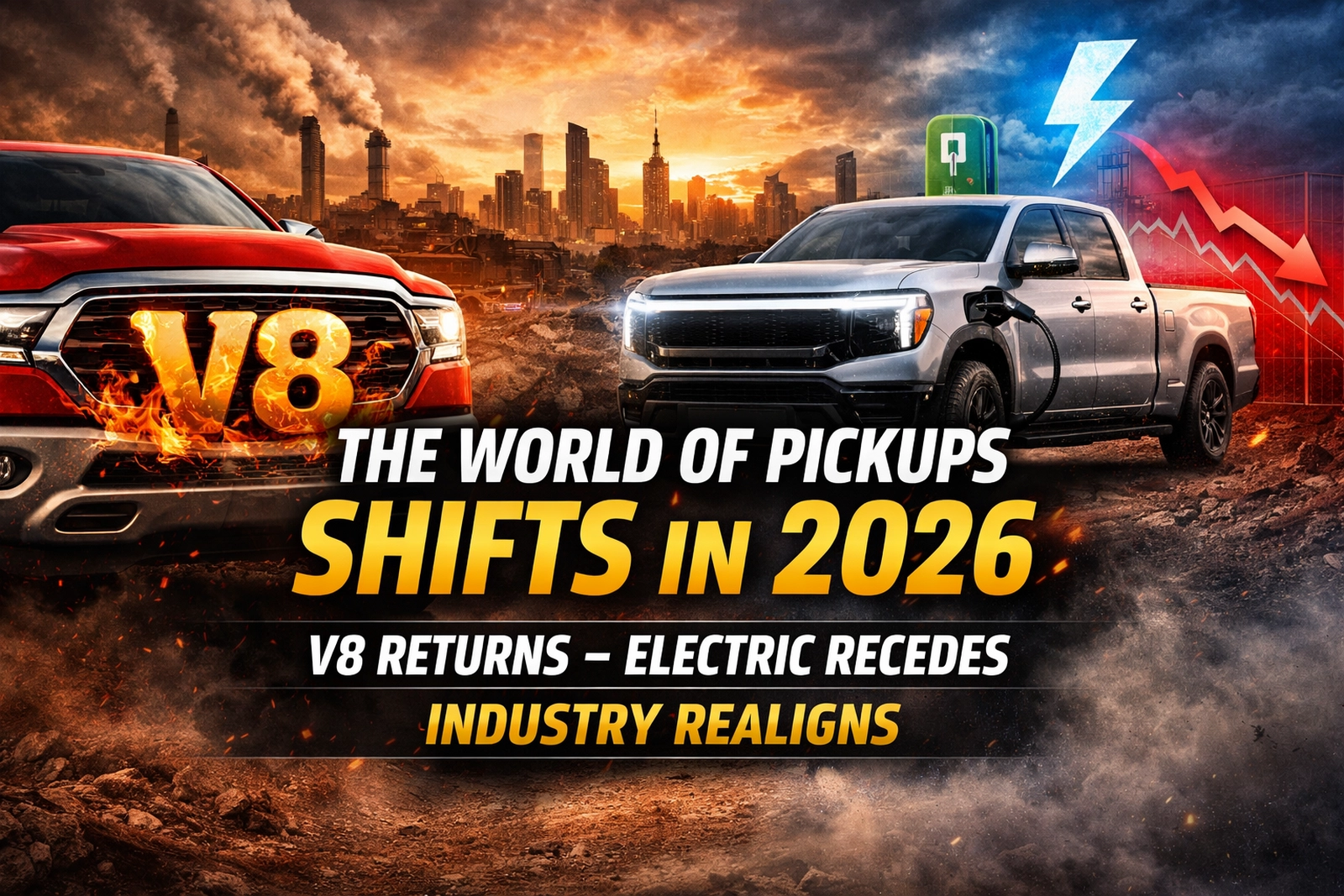
The return of the V8: a telling reversal
This is probably the most revealing news of the past year. RAM, which seemed ready to turn the page on its HEMI engines, has ultimately reversed course. (Read the article…) And not halfway.
Following the announcement of the V8’s return in the RAM 1500, the market reaction was immediate:
👉 over 10,000 orders in less than 24 hours.
This number is not insignificant.
It clearly shows that the V8 engine still holds a crucial place in the hearts of buyers — not only for emotional reasons, but also for very practical usage considerations. The V8 is not an outdated technology as some suggested, but rather a still-relevant and highly sought-after powertrain. The observed demand confirms that consumers are not ready to abandon this type of mechanical setup, especially in heavy-duty use scenarios.
But beyond the engine itself, what this reveals is a significant gap between:
👉 The vision of manufacturers
👉 And the reality of users
Because for someone who uses their truck daily — towing, working, facing harsh conditions — the V8 remains a benchmark.
Its linear power delivery allows better predictability under heavy loads, its mechanical design remains relatively simple compared to more complex modern technologies, and its overall behavior inspires confidence. Even its sound, often seen as secondary, contributes to the perception of strength and capability.
This is not just about nostalgia.
👉 It’s about real-world effectiveness.
And not halfway.
Following the announcement of the V8’s return in the RAM 1500, the market reaction was immediate:
👉 over 10,000 orders in less than 24 hours.
This number is not insignificant.
It clearly shows that the V8 engine still holds a crucial place in the hearts of buyers — not only for emotional reasons, but also for very practical usage considerations. The V8 is not an outdated technology as some suggested, but rather a still-relevant and highly sought-after powertrain. The observed demand confirms that consumers are not ready to abandon this type of mechanical setup, especially in heavy-duty use scenarios.
But beyond the engine itself, what this reveals is a significant gap between:
👉 The vision of manufacturers
👉 And the reality of users
Because for someone who uses their truck daily — towing, working, facing harsh conditions — the V8 remains a benchmark.
Its linear power delivery allows better predictability under heavy loads, its mechanical design remains relatively simple compared to more complex modern technologies, and its overall behavior inspires confidence. Even its sound, often seen as secondary, contributes to the perception of strength and capability.
This is not just about nostalgia.
👉 It’s about real-world effectiveness.
RAM makes a bold move: 10-year warranty and strategic repositioning
 RAM didn’t just bring back the V8.
The brand also introduced something that could change the game in Canada:
👉 a 10-year / 160,000 km powertrain warranty on several 2026 models.
In a context where pickup prices are extremely high — often exceeding $80,000 — and where maintenance costs continue to rise, consumers are becoming increasingly cautious in their purchasing decisions. This warranty acts as a powerful trust lever.
RAM is sending a clear message:
👉 “We stand behind our products… and we’ve got you covered.”
This approach is particularly relevant in the Canadian market. Harsh weather conditions put vehicles under extreme stress. Severe cold, freeze-thaw cycles, and intensive work usage all demand higher durability. In this context, offering an extended warranty is not just a marketing move — it’s a real response to user concerns.
We’re no longer just talking about performance.
👉 We’re talking about long-term confidence.
And very few manufacturers go this far.
RAM didn’t just bring back the V8.
The brand also introduced something that could change the game in Canada:
👉 a 10-year / 160,000 km powertrain warranty on several 2026 models.
In a context where pickup prices are extremely high — often exceeding $80,000 — and where maintenance costs continue to rise, consumers are becoming increasingly cautious in their purchasing decisions. This warranty acts as a powerful trust lever.
RAM is sending a clear message:
👉 “We stand behind our products… and we’ve got you covered.”
This approach is particularly relevant in the Canadian market. Harsh weather conditions put vehicles under extreme stress. Severe cold, freeze-thaw cycles, and intensive work usage all demand higher durability. In this context, offering an extended warranty is not just a marketing move — it’s a real response to user concerns.
We’re no longer just talking about performance.
👉 We’re talking about long-term confidence.
And very few manufacturers go this far.
Electric slows down: real-world conditions hit hard
While the V8 is making a comeback, electric is slowing down. And this is probably the biggest shift in the industry.
RAM has officially delayed — or even abandoned in its original form — its fully electric RAM 1500 REV pickup, shifting its focus toward an extended-range solution.
And this is probably the biggest shift in the industry.
RAM has officially delayed — or even abandoned in its original form — its fully electric RAM 1500 REV pickup, shifting its focus toward an extended-range solution.
Why this change?
Because the challenges are real. One of the main issues is real-world range, especially in Canada. Winter temperatures have a direct impact on battery performance. Cold reduces efficiency, forces the system to consume more energy to maintain optimal temperature, and increases energy demand for cabin heating. As a result, advertised range becomes difficult to achieve in real-world use. The second major issue is towing. When a pickup is used to pull a trailer, transport an ATV, a boat, or equipment, energy consumption increases drastically. In an electric vehicle, this translates into a rapid drop in range, severely limiting its usefulness in the very scenarios pickups are designed for. Finally, infrastructure remains a major challenge. While it is improving, it is still uneven across regions — especially outside major urban centers. In many rural or remote areas — where pickups are widely used — access to fast charging stations remains limited. Additionally, current infrastructure is not always adapted to truck-specific needs, particularly when towing.Ford is also adjusting its strategy
Ford, which had been very aggressive with the F-150 Lightning, also appears to be slowing down (Read the article…). We are seeing a gradual adaptation of its strategy. Electric model production is being adjusted based on actual demand, which turned out to be lower than expected. Ford also appears to be shifting toward hybrid solutions that better align with current market expectations. The gasoline-powered F-150 remains at the core of the lineup.
And it makes sense.
👉 Because it still perfectly meets user needs.
Ford is therefore prioritizing stability, focusing on continuity rather than rapid technological disruption. This strategy allows the company to maintain a strong market presence while developing better long-term solutions.
The gasoline-powered F-150 remains at the core of the lineup.
And it makes sense.
👉 Because it still perfectly meets user needs.
Ford is therefore prioritizing stability, focusing on continuity rather than rapid technological disruption. This strategy allows the company to maintain a strong market presence while developing better long-term solutions.
The hybrid pickup: the true compromise?

GM: quiet, but strategic
While RAM and Ford dominate the spotlight, GM is taking a more discreet approach. But this doesn’t mean inactivity. The group continues developing electric platforms while maintaining a strong internal combustion lineup. This strategy allows it to remain flexible and adapt quickly to market evolution. Historically, GM has excelled in this role — arriving with more mature solutions at the right time. It would be a mistake to underestimate their position.The pickup evolves… but its DNA remains intact

What the latest news really tells us
Taking a step back, the signals are clear. Consumers are reclaiming a central role in industry decisions. Buying behaviors are directly influencing manufacturer strategies, forcing them to adapt to a much more complex reality. Electrification is not disappearing — but it is evolving. It must now fit real-world usage instead of trying to reshape it entirely. Meanwhile, internal combustion remains essential in key segments like work and towing, where its advantages are still unmatched. Finally, the future of pickups will not rely on a single technology, but rather a combination of solutions tailored to different uses.Conclusion: a return to reality… and that’s good news
The pickup world is not in crisis. It is adjusting. A necessary adjustment. After trying to accelerate too quickly toward an electric future, the industry is returning to something fundamental: 👉 Listening to users. And in 2026, users are sending a clear message: They want power, reliability, and realistic solutions that meet their daily needs. They want trucks that can work, perform, and last — not just impress on paper. The result is a more balanced industry, better products, and a much more credible future. For real pickup owners… this is probably the best possible evolution.Foire aux questions (FAQ)
Consumer demand drove the V8 comeback. Despite electrification trends, the majority of North American truck buyers still prefer internal combustion engines, particularly V8s for their power, sound, and reliability. Ford (Raptor R), Ram (TRX), and GM all maintained V8 options, responding to clear market preference.
In 2026, V8-equipped pickups in Canada include the Ford F-150 Raptor R (5.2L supercharged, 700 hp), Ram 1500 TRX (6.2L supercharged HEMI, 702 hp), and various heavy-duty trucks. The Chevrolet Silverado and GMC Sierra 1500 also offer a naturally aspirated 6.2L V8 option.
Yes, relative to earlier projections. Ford significantly reduced F-150 Lightning production, GM pushed back Silverado EV targets, and Ram delayed its 1500 REV. Consumer adoption is happening, but more gradually than manufacturers initially predicted, partly due to charging infrastructure gaps and higher prices.
For 2026, buyers can choose the Ford F-150 with PowerBoost Hybrid (430 hp, full hybrid), the Ram 1500 with eTorque mild hybrid (48V system), or the Chevrolet Silverado with available mild hybrid. These options provide improved fuel economy without full EV commitment.
Expect a mix of powertrains: V6 turbos, V8s (especially in performance models), full hybrids, and electric. Pure EV pickups will likely represent 15–25% of the market in Canada by 2030, with hybrid and traditional options dominating. Autonomous driving features will also be more prevalent.
