
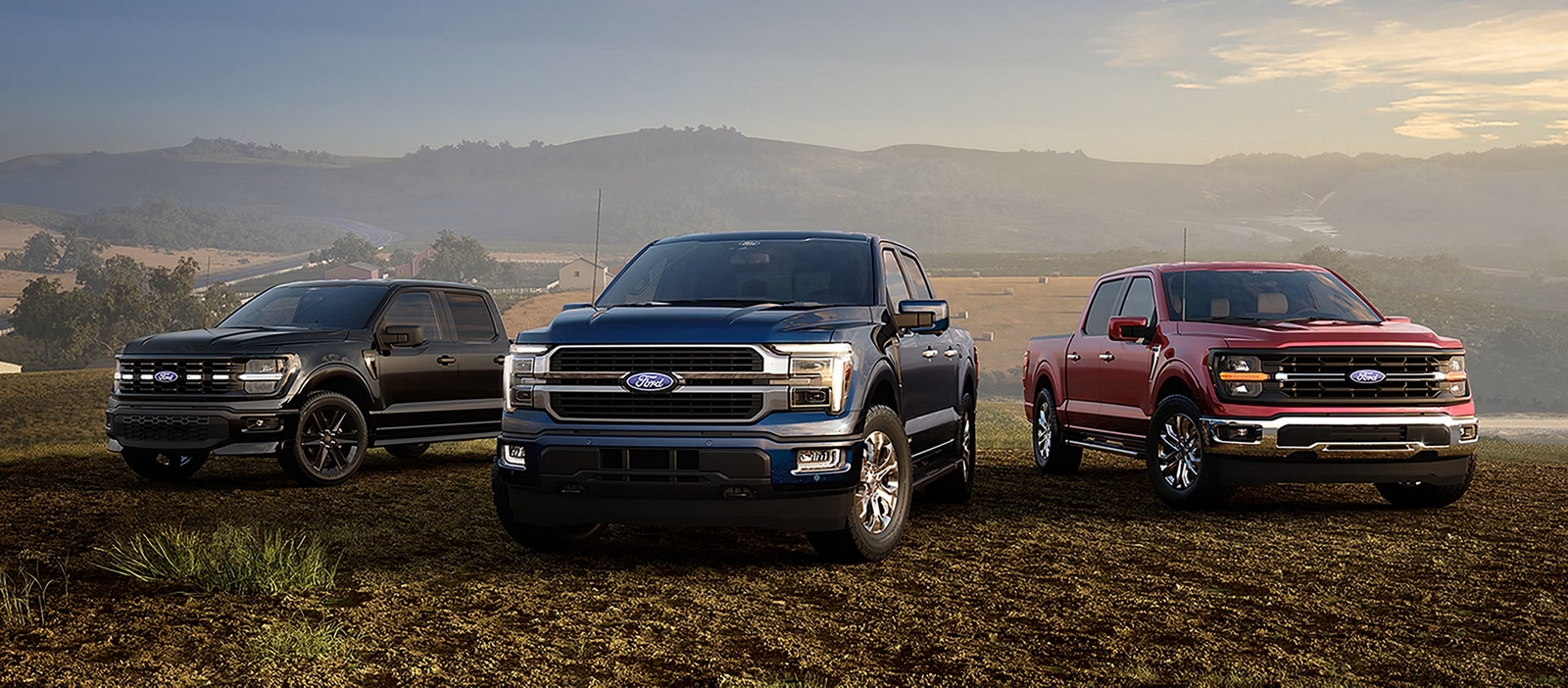
Some vehicles evolve to keep up with the market. Others define it. The Ford F-150 clearly belongs to the second group. Year after year, it remains the reference point in the full-size pickup segment—for buyers and competitors alike.
For 2026, Ford didn’t try to make headlines with flashy revolutions or abrupt marketing pivots. Instead, the F-150 follows a proven logic: strengthen what already works, refine the strong points, and address real-world irritants identified by owners.
In a Canadian context—frequent towing, long winters, and mandatory versatility—this measured approach makes a lot of sense.
A measured, deliberate… and coherent evolution
Visually, the 2026 F-150 is instantly recognizable. Ford isn’t hiding its identity. The proportions remain substantial, the stance confident, and the design continues to emphasize perceived toughness—still a key buying factor for pickup owners.
More importantly, the F-150’s design isn’t meant to impress in a parking lot. It’s built to age well, to remain credible after several winters, countless secondary roads, and repeated heavy use.
This is often where the F-150 gains ground over competitors that may be bolder stylistically, but less coherent over the long haul.
A powertrain lineup that covers nearly every use case
One of the biggest strengths of the 2026 F-150 remains the breadth of its engine lineup. Ford continues to offer a wide range of options, allowing buyers to adapt the truck to their needs—rather than adapting their needs to the truck.
Gasoline engines: the safe, proven choice
Traditional gasoline powertrains remain central to the F-150 lineup. They appeal to buyers who value mechanical simplicity, long-term predictability, and straightforward maintenance.
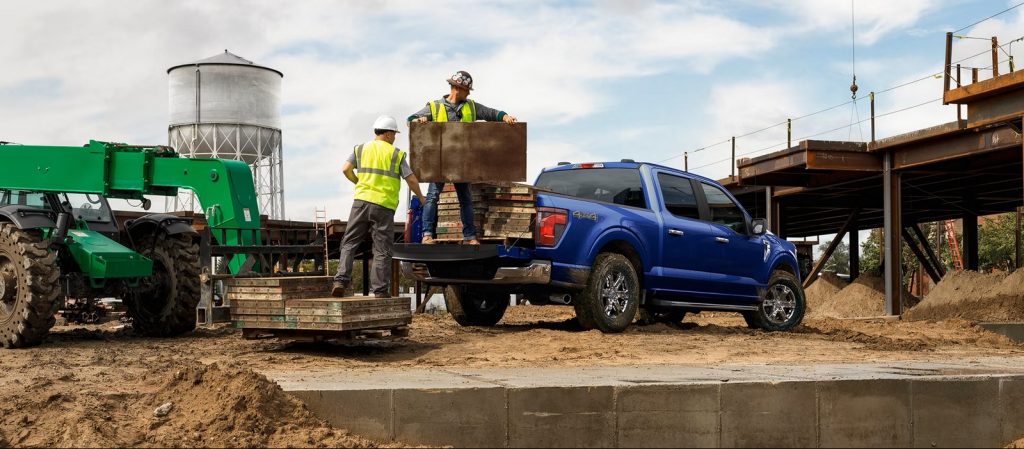
For many users—contractors, self-employed workers, cottage owners—these engines remain a logical choice, especially for regular towing or sustained use in harsh conditions.
PowerBoost hybrid: useful, but not magical
The PowerBoost hybrid system continues to be one of the F-150’s defining features. But shortcuts in interpretation should be avoided. This isn’t a “green-first” hybrid—it’s a system designed to enhance torque delivery and add functional capability.
In real-world use, its advantages are most noticeable:
- during loaded starts,
- at low speeds,
- in stop-and-go driving,
- and when powering tools or equipment via the onboard generator.
That said—and this nuance matters—a hybrid F-150 isn’t automatically more fuel-efficient. Depending on engine configuration, payload, and whether a trailer is involved, fuel consumption can match or even exceed that of a comparable gasoline model. The hybrid makes sense in specific mixed-use scenarios, not as a universal solution.

Towing: still a cornerstone of the F-150 proposition
If there’s one area where the F-150 continues to command respect, it’s towing. The numbers are impressive, but the real difference lies in the supporting tools.
Ford has long taken a pragmatic approach:
- electronic stability management,
- dedicated trailer camera views,
- trailer reverse assist,
- clear, driver-focused interfaces.
These technologies don’t replace experience, but they reduce fatigue and increase safety margins—especially for owners who tow often without being professional haulers.
As always, configuration is key. A poorly specified F-150 can quickly lose much of its theoretical advantage.

An interior designed as a real working environment
Inside, the 2026 F-150 continues a logical evolution. Ergonomics remain one of its strongest attributes. Controls are well placed, displays are easy to read, and the overall layout stays functional—even in higher trims.
Ford understands a simple reality: for many owners, the pickup has become the primary vehicle. It must handle long trips, family duties, and workdays without feeling like a compromise.
Upper trims add comfort and technology, but without drifting into unnecessary luxury. The F-150 remains a truck first—and that’s exactly what its buyers want.

A wide lineup… sometimes too wide
The sheer breadth of the F-150 lineup is both a strength and a potential trap. Between XL, XLT, Lariat, Tremor, and Raptor, there’s an F-150 for nearly every scenario—provided buyers clearly define their needs.
- XL / XLT: efficiency and value
- Lariat: daily-use comfort balance
- Tremor: harsh conditions and off-road use
- Raptor: performance and image
The problem arises when buyers choose based on image rather than actual usage. An over-equipped or oversized F-150 can quickly become unnecessarily expensive.

Reliability, maintenance, and long-term reality
In Canada, the F-150’s reputation also rests on very concrete factors: a dense dealer network, parts availability, and widespread mechanical expertise. These elements play a major role in long-term ownership costs.
That said, increasing technology and powertrain complexity require honest consideration. The more sophisticated the F-150, the more structured maintenance becomes. For some buyers, that trade-off is acceptable. For others, simplicity remains the priority.
Who the 2026 Ford F-150 is really for
The reality is that the 2026 F-150 isn’t for everyone—and that’s not a flaw.
It’s best suited for buyers who need:
- a vehicle that can do almost everything,
- frequent towing capability,
- no-compromise winter performance,
- and strong long-term value retention.
For strictly urban or occasional use, more compact formats are often more rational. But as demands increase, the F-150 naturally reclaims its place.

YourPickup.ca verdict
The 2026 Ford F-150 doesn’t try to impress—it tries to deliver, over and over again. That consistency explains why it remains the segment benchmark.
In a market where many pickups chase attention through marketing or excess, the F-150 continues to rely on a pragmatic approach tailored to Canadian realities.
Not perfect. Not universal. But exceptionally effective when properly chosen.

