

In the world of full-size pickups, the Toyota Tundra has never tried to blindly follow American formulas. Its trajectory has always been different—sometimes more conservative, sometimes out of step with market trends. For 2026, that distinctiveness remains, but it now fits within a far more modern and deliberate framework, as Toyota seeks to balance its reputation for reliability with the current demands of the segment.
The 2026 Tundra isn’t here to chase sales records or multiply variants. Instead, it targets a specific audience—buyers willing to accept certain compromises in exchange for mechanical coherence and a long-term-oriented approach.
A distinct identity in the full-size segment
It’s important to understand that the Tundra doesn’t play the same game as the Ford F-150, Ram 1500, or Chevrolet Silverado. Toyota isn’t trying to offer the widest lineup or the greatest number of configurations. The approach is more focused and more controlled.
This philosophy appeals to buyers who can feel overwhelmed by the complexity of American truck lineups. The Tundra offers a simpler framework, with fewer choices—but choices that are easier to understand. For some buyers, that clarity is a major advantage.

A modern powertrain that stays true to Toyota’s DNA
Since its redesign, the Tundra has moved away from naturally aspirated V8 engines in favour of more modern powertrains, including twin-turbo engines and a hybrid variant. For 2026, that strategy remains unchanged—a sign that Toyota fully embraces this transition.
In real-world use, these powertrains emphasize low-end torque rather than outright horsepower. The Tundra proves particularly effective during loaded starts, low-speed manoeuvres, and moderate to sustained towing.
The hybrid option—often misunderstood—is not designed purely as a fuel-saving solution. Its goal is to enhance throttle response and smoothness, while adding functional benefits for certain use cases.
Towing and payload: credible capability without exaggeration
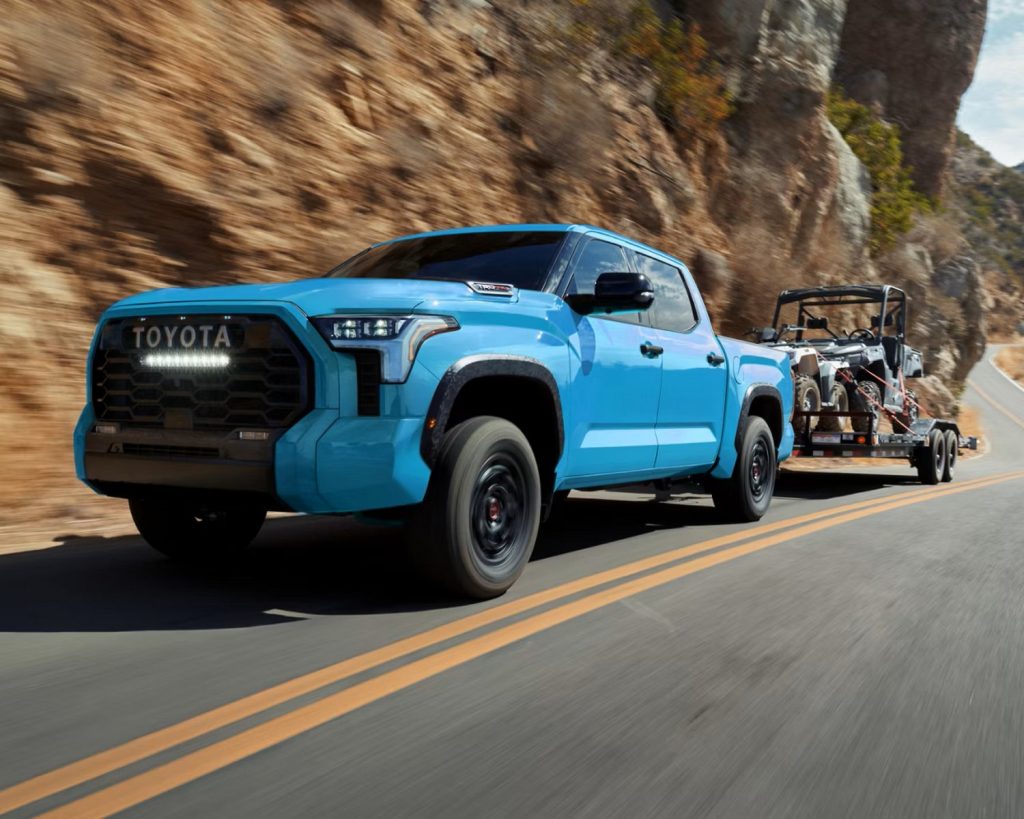
The 2026 Toyota Tundra offers towing capacities that place it firmly within the full-size pickup segment. Properly configured, it can haul substantial loads—more than enough for most travel trailers, enclosed trailers, and recreational equipment commonly used in Canada.
However, Toyota is not chasing leaderboard dominance with extreme figures. The Tundra favours a more conservative philosophy, where stability, durability, and predictability take priority over absolute maximum numbers.
For users who tow regularly without pushing extreme limits day after day, this approach results in a calmer, less stressful experience.
On-road behaviour: solid, without chasing excessive refinement
On the road, the 2026 Tundra delivers the expected full-size truck character: a strong presence, a solid stance, and stable handling—especially when the truck is loaded or towing.
When unloaded, it can feel firmer than some comfort-oriented competitors. This choice aligns with its utilitarian mission and robust structure. The Tundra doesn’t try to disguise its truck nature, and that honesty comes through in everyday driving.
For buyers who value a sense of solidity and control, this approach is reassuring.
A modernized interior with durability in mind
Inside, the 2026 Toyota Tundra takes a meaningful step toward modernity compared to previous generations. Interfaces are more current, ergonomics have been improved, and the overall environment now meets what a 2026 buyer expects.
That said, Toyota intentionally avoids excess. Materials are selected for resistance and longevity rather than visual impact. The overall atmosphere remains functional—even in higher trims.
This restraint fits well with the Tundra’s image: a truck built to last, not to chase trends.

Winter use and Canadian conditions
In Canadian conditions, the Tundra benefits from its mass, traction systems, and stability-focused calibration. On snow and slippery surfaces, it behaves predictably—especially when equipped with proper tires.
Its ground clearance and robust construction make it a credible partner for rural areas, cottage access roads, and less-maintained secondary routes. Once again, the Tundra prioritizes consistency over spectacular performance.
Reliability, resale value, and long-term logic
Toyota’s reputation for reliability remains one of the strongest arguments in favour of the 2026 Tundra. Even though the platform is now more modern and complex than in the past, Toyota continues to apply its rigorous validation and durability standards.
On the used market, the Tundra typically retains strong value, supported by steady demand and a long-lasting reputation. For buyers planning long-term ownership, this factor remains central.

Who is the 2026 Toyota Tundra really for?
The 2026 Toyota Tundra is aimed at buyers who want a reliable, coherent, and durable full-size pickup—without getting lost in an overabundance of configurations or technology.
It is particularly well suited to those who tow regularly, operate in demanding environments, and place a high value on long-term reliability. Buyers seeking extreme refinement or deep customization may find other options more appealing.

Verdict YourPickup.ca
The 2026 Toyota Tundra isn’t the flashiest or most versatile full-size pickup on paper. Instead, it offers a different vision—focused on coherence, durability, and controlled modernization.
For Canadian buyers who prioritize peace of mind and long-term reliability, the Tundra remains a serious—sometimes underestimated, but always relevant—option.

